Multiclass gas pipeline leak detection using multi-domain signals and genetic algorithm-optimized classification models
DOI:
https://doi.org/10.24036/teknomekanik.v9i1.38372Keywords:
gas pipeline leak detection, multiclass classification, acoustic signal, genetic algorithmAbstract
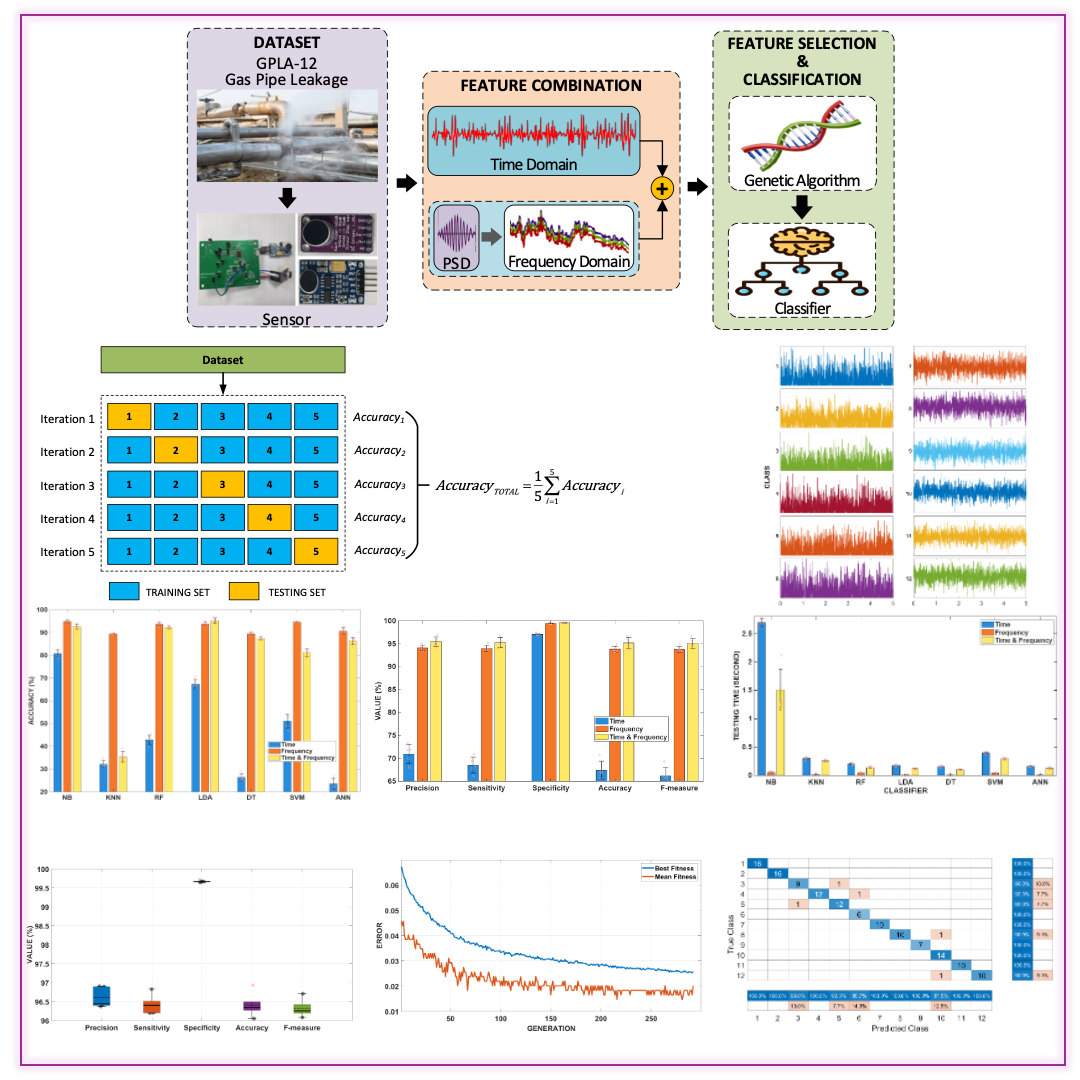
Pipeline networks are critical infrastructure for oil and gas transport because the occurrence of leaks can rapidly escalate into safety, economic, and environmental crises. Operators are practically required to identify the presence and type of leaks; however, applying multiclass recognition is challenging when labeled data and computing power are limited. Therefore, this study proposes a three-stage pipeline which consists of: (1) adopting the GPLA-12 dataset of acoustic or vibration signals spanning 12 leak types; (2) extracting multi-domain features by combining time-domain descriptors with Power Spectral Density (PSD)-based spectral features; and (3) applying a genetic algorithm (GA) as a wrapper for feature selection to enhance discriminability and reduce dimensionality, which was followed by benchmarking seven conventional classifiers and GA-based refinement of the top model with a focus on the feature subset and hyperparameters. A maximum accuracy of 96.35% was achieved on the GPLA-12 dataset with low computation time and a simple model architecture. The proposed pipeline also attained similar or better accuracy at substantially lower complexity and data requirements compared with prior deep CNN approaches. These results support timely multiclass decision-making in resource-constrained industrial settings. A key observation was that the focus was on supervised leak-type classification from acoustic or vibration signals, while localization, severity estimation, and multi-sensor fusion were beyond the scope of this study.
References
N. V. S. Korlapati, F. Khan, Q. Noor, S. Mirza, and S. Vaddiraju, “Review and analysis of pipeline leak detection methods,” Journal of Pipeline Science and Engineering, vol. 2, no. 4, p. 100074, Dec. 2022, https://doi.org/10.1016/J.JPSE.2022.100074
Y. Wang, W. Liu, Q. Zhang, L. Feng, and W. Liu, “Gas pipeline leakage detection and localization method based on VMD-DTW,” Flow Measurement and Instrumentation, vol. 102, p. 102820, Mar. 2025, https://doi.org/10.1016/J.FLOWMEASINST.2025.102820
A. P. Putra, J. W. Soedarsono, A. I. Pangesty, M. I. Y. asfar, A. Aprizal, and R. Ramadhan, “The Risk Identification On 3" GL BO3-52520 Process Pipelines Using a Risk-Based Inspection Method,” Teknomekanik, vol. 5, no. 1, pp. 28–34, May 2022, https://doi.org/10.24036/TEKNOMEKANIK.V5I1.12772
R. Xiao, P. F. Joseph, J. M. Muggleton, and J. Li, “Limits for leak noise detection in gas pipes using cross correlation,” J. Sound Vib., vol. 520, p. 116639, Mar. 2022, https://doi.org/10.1016/J.JSV.2021.116639
M. Penchev, A. A. Martinez-Morales, T. Lim, A. S. K. Raju, M. Yilmaz, and T. C. Akinci, “Leakage rates of hydrogen-methane gas blends under varying pressure conditions,” Int. J. Hydrogen Energy, Dec. 2024, https://doi.org/10.1016/J.IJHYDENE.2024.11.413
K. Li, W. Chen, Y. Zou, Z. Wang, X. Zhou, and J. Shi, “Optimized PSOMV-VMD combined with ConvFormer model: A novel gas pipeline leakage detection method based on low sensitivity acoustic signals,” Measurement, vol. 247, p. 116804, Apr. 2025, https://doi.org/10.1016/J.MEASUREMENT.2025.116804
J. Xie, W. Wang, C. Xu, M. Fu, and W. Huang, “Two-step feature extraction of acoustic emission signals for leakage detection of valves in gas pipelines,” International Journal of Pressure Vessels and Piping, vol. 212, p. 105364, Dec. 2024, https://doi.org/10.1016/J.IJPVP.2024.105364
D. Romahadi, A. G. Feleke, and R. P. Youlia, “Evaluation of Laplacian Spatial Filter Implementation in Detecting Driver Vigilance Using Linear Classifier,” International Journal of Technology, vol. 15, no. 6, pp. 1712–1729, 2024, https://doi.org/10.14716/IJTECH.V15I6.7166
C. Liu et al., “A leakage monitoring technology for buried hydrogen-doped natural gas pipelines based on vibration signal with machine learning,” Int. J. Hydrogen Energy, vol. 131, pp. 118–135, May 2025, https://doi.org/10.1016/J.IJHYDENE.2025.04.378
H. Yuan et al., “Real-time detection of urban gas pipeline leakage based on machine learning of IoT time-series data,” Measurement, vol. 242, p. 115937, Jan. 2025, https://doi.org/10.1016/J.MEASUREMENT.2024.115937
J. Liang, S. Liang, L. Ma, H. Zhang, J. Dai, and H. Zhou, “Leak detection for natural gas gathering pipeline using spatio-temporal fusion of practical operation data,” Eng. Appl. Artif. Intell., vol. 133, p. 108360, Jul. 2024, https://doi.org/10.1016/J.ENGAPPAI.2024.108360
D. Zhang et al., “A novel local deformation pipe section identification method via IMU detection data and hybrid deep learning model,” Mech. Syst. Signal Process., vol. 224, p. 112091, Feb. 2025, https://doi.org/10.1016/J.YMSSP.2024.112091
G. Weng, X. Xing, Z. Han, B. Wang, X. Zhu, and J. Zheng, “Stress prediction model of oil and gas pipeline based on magnetic-force coupling and machine learning,” Measurement, vol. 253, p. 117818, Sep. 2025, https://doi.org/10.1016/J.MEASUREMENT.2025.117818
J. Li and L. Yao, “GPLA-12: An Acoustic Signal Dataset of Gas Pipeline Leakage,” Jun. 2021, Accessed: Feb. 17, 2025. [Online]. Available: https://arxiv.org/abs/2106.10277v1
Y. Ryu, J. Oh, and J. Kwak, “Generation of artificial earthquake time histories and power spectral density for seismic analysis of nuclear power plants,” Nuclear Engineering and Technology, vol. 57, no. 3, p. 103250, Mar. 2025, https://doi.org/10.1016/J.NET.2024.10.012
P. Jain and R. Agarwal, “Sentiment Analysis using SVM, Twin SVM, and Naïve Bayes,” Proceedings - IEEE 2023 5th International Conference on Advances in Computing, Communication Control and Networking, ICAC3N 2023, pp. 456–459, 2023, https://doi.org/10.1109/ICAC3N60023.2023.10541588
S. Mishra, R. Kumar Mallick, P. Nayak, T. Naayagi Ramasamy, and G. Panda, “Dynamic Power Quality Disturbance Classification in Grid-Integrated PV Systems: Leveraging Clark Transformed Modal Voltage and Subspace Weighted KNN,” IEEE Access, vol. 12, pp. 116572–116586, 2024, https://doi.org/10.1109/ACCESS.2024.3443963
F. Tong and Y. Zhang, “Exploiting Spectral-Spatial Information Using Deep Random Forest for Hyperspectral Imagery Classification,” IEEE Geoscience and Remote Sensing Letters, vol. 19, 2022, https://doi.org/10.1109/LGRS.2021.3112198
L. Xie, Q. Qin, Y. Wang, Y. Huang, and Z. Shang, “Analysis and Modeling of Information Dissemination Process: A Study Based on LDA Topic Model and Fuzzy Comprehensive Evaluation,” 2024 5th International Conference on Computer Engineering and Application, ICCEA 2024, pp. 587–592, 2024, https://doi.org/10.1109/ICCEA62105.2024.10603977
L. A. Akinyemi, O. P. Oshinuga, O. A. Eshilokun, S. O. Oladejo, and S. O. Ekwe, “Development of Phylum Chordata Sound Recognition System using Machine Learning and Deep Learning Techniques: A Case Study of Catfish,” International Conference on Electrical, Computer and Energy Technologies, ICECET 2023, 2023, https://doi.org/10.1109/ICECET58911.2023.10389248
Z. Wang, J. Lv, C. Chen, H. Jin, X. Huang, and H. Yuan, “A Soft Measurement Model of SF6 Gas Leakage State Based on Neural Network,” 2024 IEEE 19th Conference on Industrial Electronics and Applications, ICIEA 2024, 2024, https://doi.org/10.1109/ICIEA61579.2024.10664954
J. Wan, M. Shi, Y. Liang, L. Qin, and L. Deng, “Prediction Method of Large-Diameter Ball Valve Internal Leakage Rate Based on CNN-GA-DBN,” IEEE Sens. J., vol. 23, no. 17, pp. 20321–20329, Sep. 2023, https://doi.org/10.1109/JSEN.2023.3295362
L. Yao, Y. Zhang, T. He, and H. Luo, “Natural gas pipeline leak detection based on acoustic signal analysis and feature reconstruction,” Appl. Energy, vol. 352, p. 121975, Dec. 2023, https://doi.org/10.1016/J.APENERGY.2023.121975
H. Liao et al., “Application of Natural Gas Pipeline Leakage Detection Based on Improved DRSN-CW,” Proceedings of 2021 IEEE International Conference on Emergency Science and Information Technology, ICESIT 2021, pp. 514–518, 2021, https://doi.org/10.1109/ICESIT53460.2021.9696455
X. Pan et al., “Natural gas pipeline leak detection method based on 1D CNN-Mamba integrated acoustic signal classification,” J. Phys. Conf. Ser., vol. 3011, no. 1, p. 012067, May 2025, https://doi.org/10.1088/1742-6596/3011/1/012067
Downloads
Published
Issue
Section
License
Copyright (c) 2026 Wiwit Suprihatiningsih, Dedik Romahadi, Hadi Pranoto, Rikko Putra Youlia, Fajar Anggara, Rizky Rahmatullah (Author)

This work is licensed under a Creative Commons Attribution 4.0 International License.