Effects of process parameters on the evaporative pattern casting of scrap aluminum–RHA composites
DOI:
https://doi.org/10.24036/teknomekanik.v9i1.46072Keywords:
evaporative casting, Al-RHA composite, pouring temperature, pattern thickness, physical-mechanical propertiesAbstract
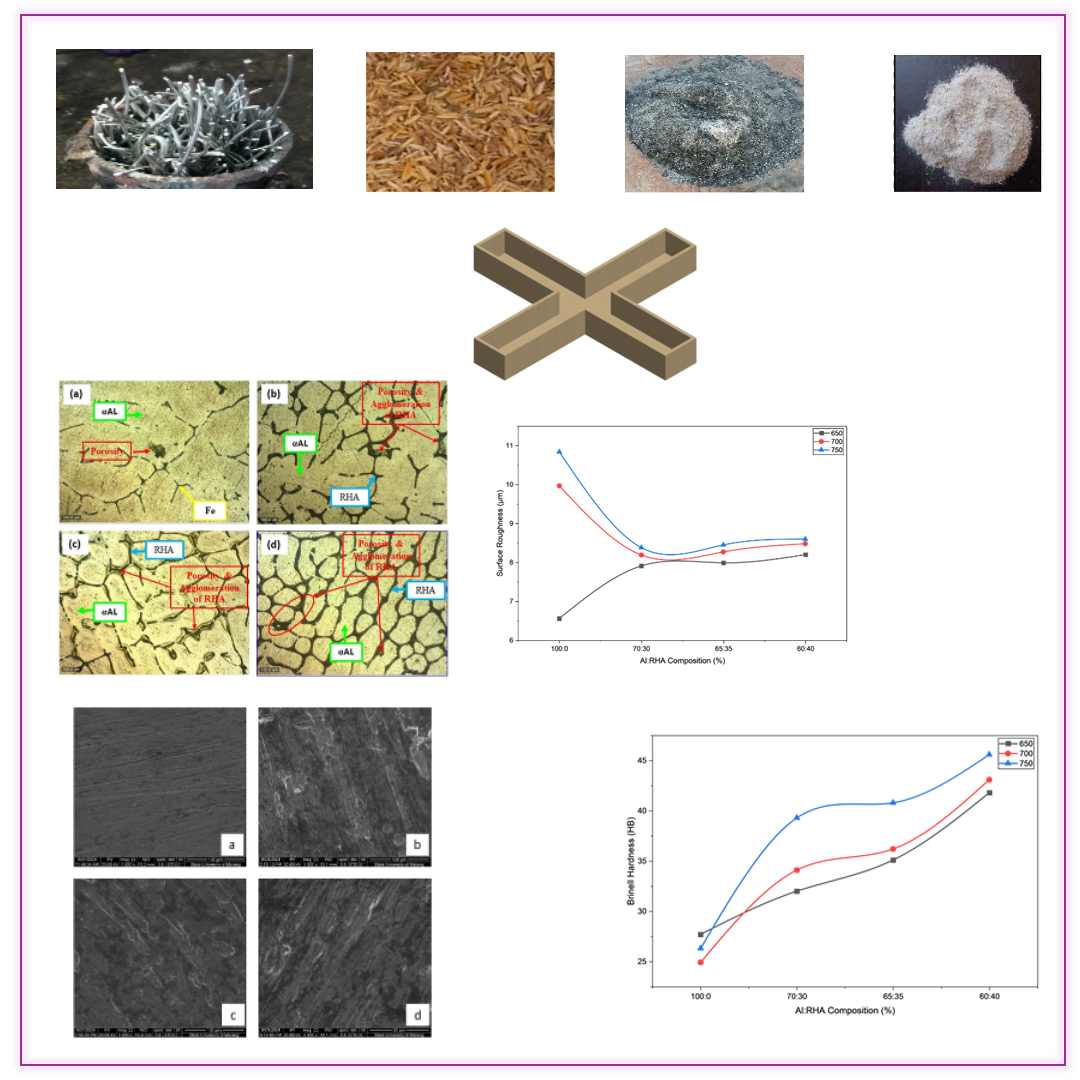
This study investigates the fabrication and characterization of aluminium matrix composites reinforced with rice husk ash (RHA), using scrap aluminium as the base material and evaporative pattern casting as the manufacturing method. The work evaluates the effects of three key independent variables: pouring temperature, aluminium (Al)-RHA composition ratios, and styrofoam pattern thickness on the resulting composite properties. The dependent variables examined include surface roughness, Brinell hardness, and dimensional shrinkage-expansion. Experimental results show that increasing the pouring temperature and adjusting the composition ratio significantly influence the mechanical and physical properties of the composites. The highest hardness (45.6 HB) and fluidity (252.65 mm) were achieved at a 60:40 composition ratio and a pouring temperature of 750 °C, albeit at the cost of increased porosity. Additionally, the styrofoam pattern thickness was found to affect the dimensional stability and surface roughness of the composites, with thicker patterns resulting in higher surface roughness. This study highlights the potential of utilizing rice husk ash as a reinforcing material in aluminium matrix composites, offering a sustainable approach to improving material properties. The findings suggest that an optimal balance of composition ratio, pouring temperature, and pattern thickness is crucial to achieving desirable mechanical and physical characteristics, with implications for advanced manufacturing processes in the materials industry.
References
R. Siswanto, R. Subagyo, M. Tamjidillah, Mahmud, and M. S. I. Setiawan, “Identifying the influence of pouring temperature, Al-RHA composition, and pattern thickness on the properties of Al-RHA composites produced by evaporative casting,” Eastern-European Journal of Enterprise Technologies, vol. 5, no. 12(131), pp. 39–49, 2024, https://doi.org/10.15587/1729-4061.2024.310274
B. Parveez, M. A. Maleque, and N. A. Jamal, “Influence of agro-based reinforcements on the properties of aluminum matrix composites: a systematic review,” Journal of Materials Science, vol. 56, no. 29. Springer, pp. 16195–16222, Oct. 01, 2021. https://doi.org/10.1007/s10853-021-06305-2
S. P. Dwivedi, P. Sharma, and A. Saxena, “Utilization of waste spent alumina catalyst and agro-waste rice husk ash as reinforcement materials with scrap aluminium alloy wheel matrix,” Proceedings of the Institution of Mechanical Engineers, Part E: Journal of Process Mechanical Engineering, vol. 234, no. 6, pp. 543–552, Dec. 2020, https://doi.org/10.1177/0954408920930634
S. R. S. M. T. M. S. A. S. Rudi, “Utilization of rice husk ash waste and scrap aluminum ascomposite materials fabricated by evaporative casting,” Mechanical Engineering for Society and Industry, vol. 4, no. 2, pp. 294–307, Dec. 2024, https://doi.org/https://doi:10.31603/mesi.12505
A. Y. Awad, M. N. Ibrahim, and M. K. Hussein, “Effects of Rice Husk Ash–Magnesium Oxide Addition on Wear Behavior of Aluminum Alloy Matrix Hybrid Composites,” Tikrit Journal of Engineering Sciences, vol. 25, no. 4, pp. 16–23, Dec. 2018, https://doi.org/10.25130/tjes.25.4.04
J. A. K. Gladston, I. Dinaharan, N. M. Sheriff, and J. D. R. Selvam, “Dry sliding wear behavior of AA6061 aluminum alloy composites reinforced rice husk ash particulates produced using compocasting,” Journal of Asian Ceramic Societies, vol. 5, no. 2, pp. 127–135, Jun. 2017, https://doi.org/10.1016/j.jascer.2017.03.005
S. Mustafa, J. Haider, P. Matteis, and Q. Murtaza, “Synthesis and Wear Behaviour Analysis of SiC- and Rice Husk Ash-Based Aluminium Metal Matrix Composites,” Journal of Composites Science, vol. 7, no. 9, Sep. 2023, https://doi.org/10.3390/jcs7090394
G. F. Aynalem, “Processing Methods and Mechanical Properties of Aluminium Matrix Composites,” Advances in Materials Science and Engineering, vol. 2020. Hindawi Limited, 2020. https://doi.org/10.1155/2020/3765791
O. O. Joseph and K. O. Babaremu, “Agricultural waste as a reinforcement particulate for aluminum metal matrix composite (AMMCs): A review,” Fibers, vol. 7, no. 4. MDPI Multidisciplinary Digital Publishing Institute, Apr. 01, 2019. https://doi.org/10.3390/fib7040033
A. Seshappa, K. Prudhvi Raj, B. Subbaratnam, U. Pranavi, N. srihithagunapriya, and S. Chhabra, “Investigations of Al-Manufacturing while 7075/RHA/Al 2 O 3 Composite by Squeeze Casting Approach",” MATEC Web of Conferences, vol. 392, p. 01027, 2024, https://doi.org/10.1051/matecconf/202439201027
R. Senthil and M. Vinayagam, “Sustainable Improvements in Mechanical and Tribological Properties of AA2017-Aluminum Nitride Composites: A Comprehensive Investigation and Numerical Analysis,” in E3S Web of Conferences, EDP Sciences, Jul. 2024. https://doi.org/10.1051/e3sconf/202455201035
E. W. A. Fanani, E. Surojo, A. R. Prabowo, and H. I. Akbar, “Recent progress in hybrid aluminum composite: Manufacturing and application,” Metals (Basel)., vol. 11, no. 12, Dec. 2021, https://doi.org/10.3390/met11121919
A. B. Gurulakshmi, M. V. Rama Sundari, S. Lakhanpal, K. Dhamija, A. Parmar, and Q. Mohammad, “Steel Chips Reinforcement in Aluminum-Based Composites: Revolutionizing Manufacturing via Stir Casting Technique,” in E3S Web of Conferences, EDP Sciences, Mar. 2024. https://doi.org/10.1051/e3sconf/202450701044
N. A. TANIŞ et al., “An Investigation of Production and Properties of RHA Reinforced Hybrid Composites by Vacuum Infiltration Method,” Uluslararası Muhendislik Arastirma ve Gelistirme Dergisi, vol. 13, no. 2, pp. 704–710, Jun. 2021, https://doi.org/10.29137/umagd.913816
S. Gopinath, M. Prince, and G. R. Raghav, “Enhancing the mechanical, wear and corrosion behaviour of stir casted aluminium 6061 hybrid composites through the incorporation of boron nitride and aluminium oxide particles,” Mater. Res. Express, vol. 7, no. 1, 2020, https://doi.org/10.1088/2053-1591/ab6c1d
M. R. Nasresfahani and M. Shamanian, “Characterization of Al1100-RHA composite developed by accumulative roll bonding,” J. Compos. Mater., vol. 53, no. 15, pp. 2047–2052, Jun. 2019, https://doi.org/10.1177/0021998318817938
G. G. Holzschuh, D. S. Dörr, J. A. R. Moraes, and S. B. Garcia, “Metal matrix production: Casting of recycled aluminum cans and incorporation of rice husk ash and magnesium,” Journal of Composite Materials, vol. 54, no. 22. SAGE Publications Ltd, pp. 3229–3241, Sep. 01, 2020. https://doi.org/10.1177/0021998320911964
N. A. Latif et al., “Crystalline rice husk silica reinforced AA7075 aluminium chips by cold compaction method,” Materwiss. Werksttech., vol. 52, no. 10, pp. 1121–1128, Oct. 2021, https://doi.org/10.1002/mawe.202000319
N. F. Mohd Joharudin, N. A. Latif, M. S. Mustapa, N. A. Badarulzaman, and M. F. Mahmod, “Physical Properties and Hardness of Treated Amorphous Silica as Reinforcement of AA7075 Recycled Aluminum Chip,” in IOP Conference Series: Materials Science and Engineering, Institute of Physics Publishing, Jun. 2020. https://doi.org/10.1088/1757-899X/824/1/012015
H. Zuhailawati, M. N. Halmy, I. P. Almanar, and B. K. Dhindaw, “Friction stir processed of 6061-t6 aluminum alloy reinforced with silica from rice husk ash,” in Advanced Materials Research, Trans Tech Publications Ltd, 2014, pp. 227–230. https://doi.org/10.4028/www.scientific.net/AMR.1024.227
R. Ahmed, K. S. Prashanth, T. Annapurna, A. Jain, P. Maan, and I. Khan, “Revolutionizing Aluminum-Based Composite Manufacturing: Harnessing Fly Ash and Rice Husk Ash Reinforcement through Stir Casting for Sustainability,” in E3S Web of Conferences, EDP Sciences, Mar. 2024. https://doi.org/10.1051/e3sconf/202450701048
Md. R. Hossain, Md. H. Ali, Md. Al Amin, Md. G. Kibria, and Md. S. Ferdous, “Fabrication and Performance Test of Aluminium Alloy-Rice Husk Ash Hybrid Metal Matrix Composite as Industrial and Construction Material,” International Journal of Engineering Materials and Manufacture, vol. 2, no. 4, pp. 94–102, Dec. 2017, https://doi.org/10.26776/ijemm.02.04.2017.03
O. O. Joseph, J. O. Dirisu, J. Atiba, S. Ante, and J. A. Ajayi, “Mechanical, and corrosive properties of AA7075 aluminium reinforced with rice husk ash particulates,” Mater. Res. Express, vol. 10, no. 11, Nov. 2023, https://doi.org/10.1088/2053-1591/ad0dd3
A. Bahrami, M. I. Pech-Canul, C. A. Gutiérrez, and N. Soltani, “Microstructure and properties of bilayer-graded Al-matrix composites by one-step pressureless infiltration of B4C/rice-husk ash preforms,” in MRS Advances, Materials Research Society, 2015, pp. 7–12. https://doi.org/10.1557/opl.2016.68
O. P. Abolusoro, M. C. Khoathane, and W. Mhike, “Mechanical and microstructural characteristics of recycled aluminium matrix reinforced with rice husk ash,” AIMS Mater. Sci., vol. 11, no. 5, pp. 918–934, 2024, https://doi.org/10.3934/MATERSCI.2024044
Z. Ahmad and S. Khan, “Mechanical characterization of LM25 alloy matrix composite reinforced with boron carbide,” Journal of Composite Materials, vol. 55, no. 22. SAGE Publications Ltd, pp. 3151–3158, Sep. 01, 2021. https://doi.org/10.1177/00219983211005513
A. H. Mohamed Ariff, O. Jun Lin, D. W. Jung, S. Mohd Tahir, and M. H. Sulaiman, “Rice Husk Ash as Pore Former and Reinforcement on the Porosity, Microstructure, and Tensile Strength of Aluminum MMC Fabricated via the Powder Metallurgy Method,” Crystals (Basel)., vol. 12, no. 8, Aug. 2022, https://doi.org/10.3390/cryst12081100
V. Gupta, B. Singh, and R. K. Mishra, “Microstructural and mechanical characterization of novel AA7075 composites reinforced with rice husk ash and carbonized eggshells,” Proceedings of the Institution of Mechanical Engineers, Part L: Journal of Materials: Design and Applications, vol. 235, no. 12, pp. 2666–2680, Dec. 2021, https://doi.org/10.1177/14644207211031265
A. Chinnamahammad Bhasha and K. Balamurugan, “Fabrication and property evaluation of Al 6061 + x% (RHA + TiC) hybrid metal matrix composite,” SN Appl. Sci., vol. 1, no. 9, Sep. 2019, https://doi.org/10.1007/s42452-019-1016-0
T. Hasan, M. Wadud, M. H. Niaz, Md. K. Uddin, and M. S. Islam, “Fabrication and Characterization of Rice Husk Ash Reinforced Aluminium Matrix Composite,” Malaysian Journal on Composites Science and Manufacturing, vol. 14, no. 1, pp. 34–43, Jul. 2024, https://doi.org/10.37934/mjcsm.14.1.3443
M. Laad, V. S. Jatti, and S. Yadav, “Comparative Study between SiC Reinforced Al 64430 Metal Matrix Composites and RHA Reinforced Al 64430 Metal Matrix Composites,” Adv. Mat. Res., vol. 1119, pp. 234–238, Jul. 2015, https://doi.org/10.4028/www.scientific.net/amr.1119.234
N. Srivast, L. K. Singh, and B. Kamesh, “Multiscale Modelling and Simulation of 3D Effective Homogenization for Material Properties of MWCNT and RHA Reinforced in Al P0507 Matrix Composite.” Jun. 28, 2023. https://doi.org/10.21203/rs.3.rs-3102520/v1
S. Saravanakumar, S. Gopalakrishnan, and K. Kalaiselvan, “Development of empirical relationships for prediction of mechanical and wear behavior of copper matrix surface composite by friction stir processing technique,” Archives of Metallurgy and Materials, vol. 66, no. 2, pp. 617–626, 2021, https://doi.org/10.24425/amm.2021.135899
Z. H. Li, H. Yan, Z. Hu, and X. C. Song, “Fluidity of ADC12 + xLa aluminum alloys,” Rare Metals, vol. 40, no. 5, pp. 1191–1197, May 2021, https://doi.org/10.1007/s12598-014-0383-3
H. S. Bang, H. I. Kwon, S. B. Chung, D. U. Kim, and M. S. Kim, “Experimental Investigation and Numerical Simulation of the Fluidity of A356 Aluminum Alloy,” Metals (Basel)., vol. 12, no. 11, Nov. 2022, https://doi.org/10.3390/met12111986
Zayad M. Sheggaf, Sharafaddeen S. Wanis Ehzazat, and Almabrouk A. Dhaw Esdeira, “Fluidity of Aluminum Piston Alloy with Different Amount of Pouring Temperature,” Bani Waleed University Journal of Humanities and Applied Sciences, vol. 8, no. 3, pp. 31–36, Sep. 2023, https://doi.org/10.58916/jhas.v8i3.111
I. Dinaharan, K. Kalaiselvan, and N. Murugan, “Influence of rice husk ash particles on microstructure and tensile behavior of AA6061 aluminum matrix composites produced using friction stir processing,” Composites Communications, vol. 3, pp. 42–46, Mar. 2017, https://doi.org/10.1016/j.coco.2017.02.001
Mohammed A. Abuqunaydah, Zayad M. Sheggaf, Muheieddin Meftah Elghanudi, and Salem A. Salem, “Recyclability of aluminium piston alloy,” Bani Waleed University Journal of Humanities and Applied Sciences, vol. 8, no. 3, pp. 99–103, 2023, https://doi.org/10.58916/jhas.v8i3.122
Downloads
Published
Issue
Section
License
Copyright (c) 2026 Rudi Siswanto, Abdul Ghofur, Rachmat Subagyo, Mastiadi Tamjidillah, Mahmud Mahmud, Ma’ruf Ma’ruf, Adi Nordiman (Author)

This work is licensed under a Creative Commons Attribution 4.0 International License.
How to Cite
Share