Optimization of bio-based cellulose-phosphate hydrogel production from rice husk waste using the Taguchi method
DOI:
https://doi.org/10.24036/teknomekanik.v9i1.47172Keywords:
cellulose, extraction, hydrogel, rice husk, Taguchi methodAbstract
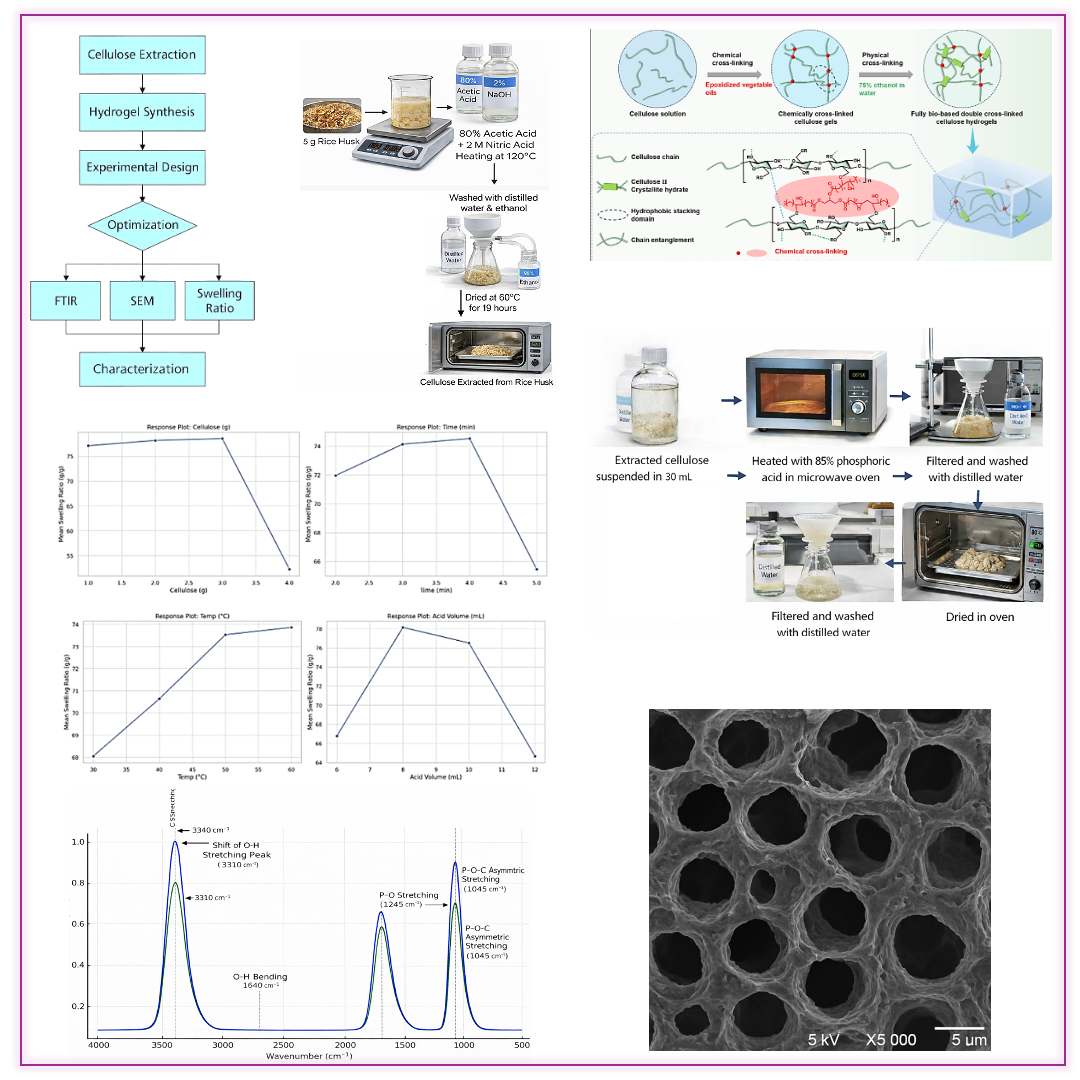
This work reports the development and statistical optimization of a fully Bio-based absorbent hydrogel synthesized from rice husk–derived cellulose via phosphoric acid crosslinking. Cellulose was extracted through sequential chemical treatments and subsequently converted into a phosphate-crosslinked hydrogel using a controlled synthesis process. A Taguchi L16 (4⁵) orthogonal array was employed to optimize four key synthesis parameters: cellulose content, reaction time, heating temperature, and phosphoric acid volume. Hydrogel structure and morphology were characterized using Fourier Transform Infrared Spectroscopy (FTIR) and Scanning Electron Microscopy (SEM). FTIR results confirmed the formation of phosphate ester linkages, indicating successful crosslinking, while SEM observations revealed a porous and interconnected network structure favorable for water absorption. The optimized hydrogel formulation achieved a maximum swelling ratio of 91.25 g/g, demonstrating effective absorbent performance despite the absence of synthetic monomers or grafting agents. These findings indicate that rice husk waste can be efficiently valorized into an environmentally benign absorbent material through a simple and statistically guided synthesis route, supporting sustainable hydrogel development and agricultural waste utilization.
References
R. A. Rather, M. A. Bhat, and A. H. Shalla, “An insight into synthetic and physiological aspects of superabsorbent hydrogels based on carbohydrate type polymers for various applications: A review,” Carbohydrate Polymer Technologies and Applications, vol. 3. Elsevier Ltd, Jun. 01, 2022. https://doi.org/10.1016/j.carpta.2022.100202
M. Muhammad, M. Tawfic, and A. Elsabbagh, “Review of design and manufacturing of superabsorbent polymers (SAPs) hydrogel for agriculture in arid areas,” Discover Materials, vol. 4, no. 1. Discover, Dec. 01, 2024. https://doi.org/10.1007/s43939-024-00114-5
M. Manuel and A. Jennifer, “Review Article: A Review on Starch and CelluloseEnhanced Superabsorbent Hydrogel,” Journal of Chemical Reviews, vol. 5, no. 2. Sami Publishing Company, pp. 183–203, Apr. 01, 2023. https://doi.org/10.22034/jcr.2023.382452.1209
A. Abdulhameed, H. Mbuvi, E. Changamu, I. Githinji, and F. Maingi, “Synthesis and characterization of cellulose phosphate-based superabsorbent hydrogels from rice husk under microwave heating,” Next Materials, vol. 6, Jan. 2025, https://doi.org/10.1016/j.nxmate.2024.100400
N. Zhai and B. Wang, “Preparation of fast-swelling porous superabsorbent hydrogels with high saline water absorbency under pressure by foaming and post surface crosslinking,” Sci. Rep., vol. 13, no. 1, Dec. 2023, https://doi.org/10.1038/s41598-023-40563-1
Y. Qin, H. Li, H. X. Shen, C. F. Wang, and S. Chen, “Rapid Preparation of Superabsorbent Self-Healing Hydrogels by Frontal Polymerization,” Gels, vol. 9, no. 5, May 2023, https://doi.org/10.3390/gels9050380
A. Abdulhameed, H. Mbuvi, E. Changamu, I. Githinji, and F. Maingi, “Synthesis and characterization of cellulose phosphate-based superabsorbent hydrogels from rice husk under microwave heating,” Next Materials, vol. 6, Jan. 2025, https://doi.org/10.1016/j.nxmate.2024.100400
M. M. Ghobashy et al., “Improving Impact of Poly (Starch/Acrylic Acid) Superabsorbent Hydrogel on Growth and Biochemical Traits of Sunflower Under Drought Stress,” J. Polym. Environ., vol. 30, no. 5, pp. 1973–1983, May 2022, https://doi.org/10.1007/s10924-021-02322-z
R. Kamboj et al., “Optimized pure cellulose from rice straw using low alkali concentration for sustainable nanocellulose and nanohydrogel production with enhanced dye reduction,” Int. J. Biol. Macromol., vol. 303, Apr. 2025, https://doi.org/10.1016/j.ijbiomac.2025.140364
T. Sooksawat, K. Ngaopok, S. Siripornadulsil, S. Amnuaypanich, M. Attapong, and W. Siripornadulsil, “Sustainable production of polyhydroxybutyrate biopolymers and cellulose microfibers from sugarcane waste,” Process Biochemistry, vol. 150, pp. 134–147, Mar. 2025, https://doi.org/10.1016/j.procbio.2024.12.022
Y. Zhang et al., “Application of Collagen-Based Hydrogel in Skin Wound Healing,” Gels, vol. 9, no. 3. MDPI, Mar. 01, 2023. https://doi.org/10.3390/gels9030185
G. M. Cholant et al., “Polyvinyl Alcohol Films Reinforced with Nanocellulose from Rice Husk,” Macromol, vol. 5, no. 1, Mar. 2025, https://doi.org/10.3390/macromol5010006
A. K. Rana, V. K. Gupta, P. Hart, and V. K. Thakur, “Cellulose-alginate hydrogels and their nanocomposites for water remediation and biomedical applications,” Environmental Research, vol. 243. Academic Press Inc., Feb. 15, 2024. https://doi.org/10.1016/j.envres.2023.117889
H. Omidian, A. Akhzarmehr, and S. D. Chowdhury, “Advancements in Cellulose-Based Superabsorbent Hydrogels: Sustainable Solutions across Industries,” Gels, vol. 10, no. 3. Multidisciplinary Digital Publishing Institute (MDPI), Mar. 01, 2024. https://doi.org/10.3390/gels10030174
T. Hu and A. C. Y. Lo, “Collagen–alginate composite hydrogel: Application in tissue engineering and biomedical sciences,” Polymers (Basel)., vol. 13, no. 11, Jun. 2021, https://doi.org/10.3390/polym13111852
D. Das, N. Chingakham, M. Sarma, S. Basu, and S. Bhaladhare, “Cellulose-based biodegradable superabsorbent hydrogel: A sustainable approach for water conservation and plant growth in agriculture,” Int. J. Biol. Macromol., vol. 305, May 2025, https://doi.org/10.1016/j.ijbiomac.2025.141176
Y. W. Ding, X. W. Zhang, C. H. Mi, X. Y. Qi, J. Zhou, and D. X. Wei, “Recent advances in hyaluronic acid-based hydrogels for 3D bioprinting in tissue engineering applications,” Smart Materials in Medicine, vol. 4. KeAi Communications Co., pp. 59–68, Jan. 01, 2023. https://doi.org/10.1016/j.smaim.2022.07.003
J. de D. M. Ufitikirezi et al., “Agricultural Waste Valorization: Exploring Environmentally Friendly Approaches to Bioenergy Conversion,” Sustainability (Switzerland) , vol. 16, no. 9. Multidisciplinary Digital Publishing Institute (MDPI), May 01, 2024. https://doi.org/10.3390/su16093617
E. N. Pistikopoulos and Y. Tian, “Annual Review of Chemical and Biomolecular Engineering Advanced Modeling and Optimization Strategies for Process Synthesis,” vol. 30, p. 34, 2025, https://doi.org/10.1146/annurev-chembioeng
S. Aprilyanti and F. Suryani, “Application of taguchi experiment design to reduce lignin contents of rice straw,” International Journal of Industrial Optimization, vol. 1, no. 2, 2020.
A. R. Altaf et al., “One-step synthesis of renewable magnetic tea-biochar derived from waste tea leaves for the removal of Hg0from coal-syngas,” J. Environ. Chem. Eng., vol. 9, no. 4, Aug. 2021, https://doi.org/10.1016/j.jece.2021.105313
K. Saada, S. Amroune, A. Belaadi, M. Zaoui, I. M. H. Alshaikh, and D. Ghernaout, “Enhancing the Mechanical Characteristics of Eco-Friendly Composite Materials: Taguchi and RSM Optimization,” Journal of Natural Fibers, vol. 21, no. 1, 2024, https://doi.org/10.1080/15440478.2024.2427704
H. Omidian, A. Akhzarmehr, and S. D. Chowdhury, “Advancements in Cellulose-Based Superabsorbent Hydrogels: Sustainable Solutions across Industries,” Gels, vol. 10, no. 3. Multidisciplinary Digital Publishing Institute (MDPI), Mar. 01, 2024. https://doi.org/10.3390/gels10030174
B. G. Rodrigues, Á. H. M. José, C. A. Prado, D. Rodrigues, and R. C. L. B. Rodrigues, “Optimizing corncob pretreatment with eco-friendly deep eutectic solvents to enhance lignin extraction and cellulose-to-glucose conversion,” Int. J. Biol. Macromol., vol. 283, Dec. 2024, https://doi.org/10.1016/j.ijbiomac.2024.137432
S. Madhavarao, V. V. S. Kesava Rao, C. Rama Bhadri Raju, T. Buddi, D. V. Nemova, and R. D. Nautiyal, “Optimization of wire-cut electric discharge machining process parameters for hybrid MMC(AA7475/ZrO2/gr) using Taguchi method: an experimental study,” Cogent Eng., vol. 11, no. 1, 2024, https://doi.org/10.1080/23311916.2024.2328822
S. Sidi Habib, S. Torii, K. M. S, and A. Charivuparampil Achuthan Nair, “Optimization of the Factors Affecting Biogas Production Using the Taguchi Design of Experiment Method,” Biomass (Switzerland), vol. 4, no. 3, pp. 687–703, Sep. 2024, https://doi.org/10.3390/biomass4030038
C. R. Chilakamarry, A. M. Mimi Sakinah, A. W. Zularism, I. A. Khilji, and S. Kumarasamy, “Glycerol Waste to Bio-Ethanol: Optimization of Fermentation Parameters by the Taguchi Method,” J. Chem., vol. 2022, 2022, https://doi.org/10.1155/2022/4892992
Y. Oladosu et al., “Superabsorbent Polymer Hydrogels for Sustainable Agriculture: A Review,” Horticulturae, vol. 8, no. 7. MDPI, Jul. 01, 2022. https://doi.org/10.3390/horticulturae8070605
L. J. Huang, W. J. Lee, and Y. C. Chen, “Bio-Based Hydrogel and Aerogel Composites Prepared by Combining Cellulose Solutions and Waterborne Polyurethane,” Polymers (Basel)., vol. 14, no. 1, Jan. 2022, https://doi.org/10.3390/polym14010204
S. Tanpichai, F. Phoothong, and A. Boonmahitthisud, “Superabsorbent cellulose-based hydrogels cross-liked with borax,” Sci. Rep., vol. 12, no. 1, Dec. 2022, https://doi.org/10.1038/s41598-022-12688-2
P. Wei, W. Chen, Q. Song, Y. Wu, and Y. Xu, “Superabsorbent hydrogels enhanced by quaternized tunicate cellulose nanocrystals with adjustable strength and swelling ratio,” Cellulose, vol. 28, no. 6, pp. 3723–3732, Apr. 2021, https://doi.org/10.1007/s10570-021-03776-z
B. I. Mbuya, M. B. Kime, and A. M. D. Tshimombo, “Comparative Study of Approaches based on the Taguchi and ANOVA for Optimising the Leaching of Copper–Cobalt Flotation Tailings,” Chem. Eng. Commun., vol. 204, no. 4, pp. 512–521, Apr. 2017, https://doi.org/10.1080/00986445.2017.1278588
Downloads
Published
Issue
Section
License
Copyright (c) 2026 Selvia Aprilyanti, Irnanda Pratiwi, Winny Andalia, Tine Aprianti, Hariman Al Faritzie (Author)

This work is licensed under a Creative Commons Attribution 4.0 International License.