
Hydrodynamic optimization of a Sweptback Stern Foil for resistance reduction in flat-hull ships: A CFD-based extension of the Hull Vane concept
DOI:
https://doi.org/10.24036/teknomekanik.v9i1.54872Keywords:
flat-hull ship, flow simulation, energy-saving device, affordable and clean energy, ship resistance reductionAbstract
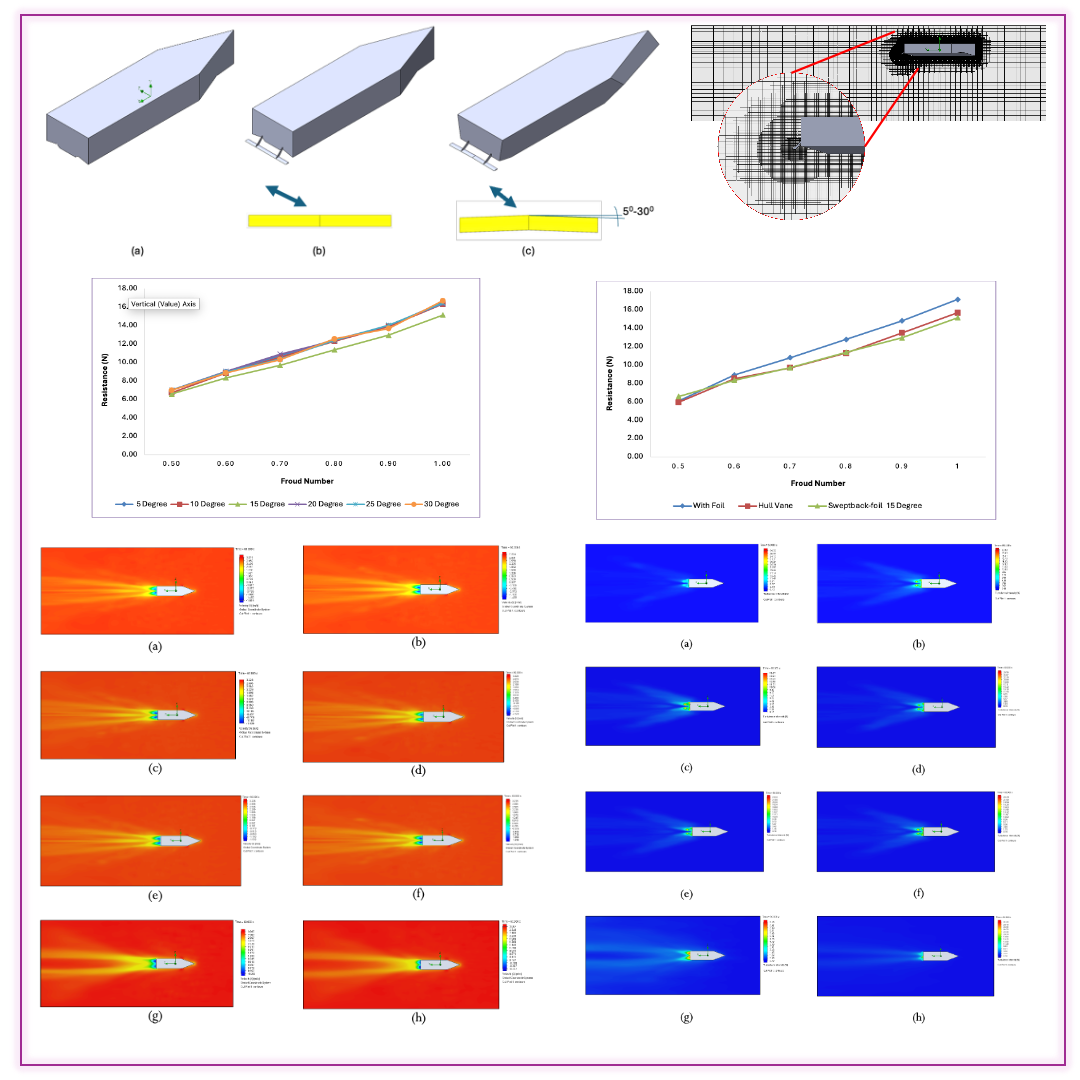
Flat-hull ships are known to have higher resistance than streamlined hulls. Although the Hull Vane® concept has been proven effective as a stern-mounted energy-saving device through pressure-field modification and stern-wave interaction, most previous studies have focused on straight-foil configurations (straight planform). The effect of planform shape optimization, particularly the sweptback configuration, on the hydrodynamic performance of flat-hull ships is limited in the literature. This study modifies the geometry of a Hull Vane® into a sweptback stern foil and evaluates its performance using Computational Fluid Dynamics simulations. The results show that a 15° sweptback angle yields the greatest reduction in total drag. Velocity contour analysis shows a narrower wake and a more uniform velocity-gradient distribution in the stern area for the 15° swept-back stern-foil configuration compared to other configurations. Meanwhile, the turbulence length distribution shows a tendency toward reduced intensity of large-scale turbulent structures behind the ship, indicating improved wake-flow characteristics. The identified drag reduction mechanism primarily stems from improved pressure recovery and modified pressure distribution in the stern area, which is consistent with the working principle of Hull Vane®. Optimizing the sweptback planform geometry yields more efficient flow interaction than the straight-foil configuration. These findings indicate that planform optimization is an important design parameter in the development of stern foils to improve the hydrodynamic efficiency of medium-to high-speed commercial vessels.
References
R. A. Nabawi, S. Syahril, and S. Salmat, “Stability Study of Flat Hull Ship for Fishing Tourism,” Teknomekanik, vol. 3, no. 2, pp. 80–85, Dec. 2020, https://doi.org/10.24036/teknomekanik.v3i2.9272
R. A. Nabawi, S. Syahril, and R. Refdinal, “The Study of Shape Flat Hull Ship Toward Resistance,” TEM Journal, pp. 1669–1673, Nov. 2022, https://doi.org/10.18421/TEM114-30
Y. Xue et al., “A combined experimental and numerical approach to predict ship resistance and power demand in broken ice,” Ocean Engineering, vol. 292, p. 116476, Jan. 2024, https://doi.org/10.1016/j.oceaneng.2023.116476
L. Bilgili, “Determination of the weights of external conditions for ship resistance,” Ocean Engineering, vol. 276, p. 114141, May 2023, https://doi.org/10.1016/j.oceaneng.2023.114141
A. G. Avci and B. Barlas, “An experimental investigation of interceptors for a high speed hull,” International Journal of Naval Architecture and Ocean Engineering, vol. 11, no. 1, pp. 256–273, Jan. 2019, https://doi.org/10.1016/j.ijnaoe.2018.05.001
C. Celik, D. B. Danisman, P. Kaklis, and S. Khan, “An investigation into the effect of the hull vane on the ship resistance in openfoam,” Sustainable Development and Innovations in Marine Technologies - Proceedings of the 18th International Congress of the International Maritime Association of the Mediterranean, IMAM 2019, pp. 136–141, 2020, https://doi.org/10.1201/9780367810085-17
M. A. Murdianto, M. A. Budiyanto, and M. F. Syahrudin, “Application of stern foil on full draft patrol vessel at high speed condition using computational fluid dynamics (CFD) method,” in AIP Conference Proceedings, 2020, pp. 1–6. https://doi.org/10.1063/5.0013750
M. A. Budiyanto, M. F. Syahrudin, and M. A. Murdianto, “Investigation of the effectiveness of a stern foil on a patrol boat by experiment and simulation,” Cogent Eng., vol. 7, no. 1, pp. 1–17, Jan. 2020, https://doi.org/10.1080/23311916.2020.1716925
H. Dwiputera, N. Y. Prawira, M. A. Budiyanto, and M. Arif, “Effect of Angle of Attack Variation of Stern Foil on High-Speed Craft on Various Speed with Computational Fluid Dynamics Method,” International Journal of Technology, vol. 11, no. 7, pp. 1359–1369, 2020, https://doi.org/10.14716/ijtech.v11i7.4467
K. Uithof, P. Van Oossanen, N. Moerke, P. G. Van Oossanen, and K. S. Zaaijer, “an Update on the Development of the Hull Vane ®,” 9th International Conference on High-Performance Marine Vehicles (HIPER), Athens, 2014.
K. Uithof, N. Hagemeister, B. Bouckaert, P. G. Van Oossanen, N. Moerke, and B. V. Hull Vane, “A systematic comparison of the influence of the hull Vane®, inter-ceptors, trim wedges, and ballasting on the performance of the 50M amecrc series #13 patrol vessel,” in RINA, Royal Institution of Naval Architects - Warship 2016: Advanced Technologies in Naval Design, Construction, and Operation, 2016.
P. Van Oossanen, “Vessel provided with a foil situated below the waterline,” 2006
R. A. Nabawi, Syahril, and Primawati, “Study Reduction of Resistance on The Flat Hull Ship of The Semi-Trimaran Model: Hull Vane Vs Stern Foil,” CFD Letters, vol. 13, no. 12, pp. 32–44, Dec. 2021, https://doi.org/10.37934/CFDL.13.12.3244
Y. K. Demirel, O. Turan, and A. Incecik, “Predicting the effect of biofouling on ship resistance using CFD,” Applied Ocean Research, vol. 62, pp. 100–118, 2017, https://doi.org/10.1016/j.apor.2016.12.003
Muhammad Arif Budiyanto, Naufal Yudha Prawira, and Haekal Dwiputra, “Lift-to-Drag Ratio of the Application of Hydrofoil With Variation Mounted Position on High-Speed Patrol Vessel,” CFD Letters, vol. 13, no. 5, pp. 1–9, Jun. 2021, https://doi.org/10.37934/cfdl.13.5.19
O. M. Faltinsen, Hydrodynamics of High-Speed Marine Vehicles. Cambridge University Press, 2006. https://doi.org/10.1017/CBO9780511546068
ITTC, “Recommended Procedures and Guidelines: Practical Guidelines for Ship CFD,” in International Towing Tank Conference, 2011, pp. 1–18.
F. Stern, R. V. Wilson, H. W. Coleman, and E. G. Paterson, “Comprehensive Approach to Verification and Validation of CFD Simulations—Part 1: Methodology and Procedures,” J. Fluids Eng., vol. 123, no. 4, pp. 793–802, Dec. 2001, https://doi.org/10.1115/1.1412235
L. Larsson and E. Baba, Ship resistance and flow computations, vol. 5. 1996.
ITTC, “Report 7.5-03-02-04: Practical Guidelines for Ship Resistance CFD,” in ITTC Quality System Manual - Recommended Procedures and Guidlines, 2014, pp. 1–10.
ITTC, “Report 7.5-03-02-03: Practical Guidelines for Ship CFD Applications,” in ITTC – Recommended Procedures and Guidelines, 2011, pp. 1–18.
S. Oyuela, H. R. D. Ojeda, F. P. Arribas, A. D. Otero, and R. Sosa, “Investigating Fishing Vessel Hydrodynamics by Using EFD and CFD Tools, with Focus on Total Ship Resistance and Its Components,” J. Mar. Sci. Eng., vol. 12, no. 4, p. 622, Apr. 2024, https://doi.org/10.3390/jmse12040622
H. Ferré, P. Goubault, C. Yvin, and B. Bouckaert, “Improving the nautical performance of a surface ship with the Hull Vane ® appendage,” ATMA, vol. 2738, no. 1, 2019.
S. Tripathi and R. Vijayakumar, “Numerical and experimental study of stern flaps impact on resistance and propulsion of high–speed displacement ships,” Ocean Engineering, vol. 292, p. 116483, Jan. 2024, https://doi.org/10.1016/j.oceaneng.2023.116483
Downloads
Published
Issue
Section
License
Copyright (c) 2026 Rahmat Azis Nabawi, Budi Syahri, Yogi Dian Alfana, Donny Fernandez (Author)

This work is licensed under a Creative Commons Attribution 4.0 International License.
How to Cite
Share